

Holographic displays are no longer the stuff of science fiction movies. Walk into any cutting-edge office today and you’ll spot floating 3D interfaces replacing traditional monitors, complete with gesture controls and spatial computing capabilities that would have seemed impossible just five years ago.
The workspace revolution is happening faster than most predicted. Companies like Microsoft, Meta, and newcomers such as Light Field Lab have pushed holographic display technology from experimental prototypes to production-ready devices that are reshaping how we interact with digital content. These aren’t just fancy screens—they’re fundamentally changing how teams collaborate, designers create, and professionals visualize complex data.

Desktop Holographic Displays: The New Monitor Standard
The HoloDesk Pro 27 from Dimensional Displays leads the desktop category at $3,200. This device projects genuine volumetric holograms up to 15 inches above its surface, with 4K resolution per viewing angle. Unlike previous “holographic” displays that only worked from specific positions, the HoloDesk Pro maintains image clarity from any viewing angle within a 120-degree cone.
Microsoft’s HoloScreen 4K takes a different approach at $2,800. Instead of projecting above the surface, it creates the illusion of depth within a 32-inch transparent display panel. The real advantage here is seamless integration with existing desk setups—no need to rearrange your workspace or adjust lighting conditions.
For budget-conscious buyers, the Looking Glass Portrait 4K at $899 offers an entry point into holographic displays. While smaller at 15.6 inches, it provides the same core experience of manipulating 3D objects with hand gestures, making it ideal for individual professionals rather than team presentations.
Key Features Driving Adoption
Real-time collaboration tops the feature list. Multiple users can manipulate the same 3D model simultaneously, with changes visible instantly to all participants. The Spatial Systems Hologram Hub ($4,500) excels here, supporting up to eight concurrent users working on the same holographic object.
Eye tracking integration eliminates the need for controllers or keyboards in many scenarios. Simply look at a menu item or 3D object to select it, then use hand gestures for manipulation. This natural interaction method reduces learning curves significantly compared to traditional VR headsets.
Portable Holographic Projectors for Mobile Professionals
The HoloLens Travel Projector weighs just 2.1 pounds but projects crisp holograms up to 24 inches wide. At $1,899, it’s designed for consultants, architects, and sales professionals who need to present 3D content on-site. Battery life reaches 4 hours of continuous projection, with rapid 30-minute charging capabilities.
Lightspace Mobile takes portability further with its tablet-sized form factor. This $1,200 device unfolds to create a holographic workspace anywhere, projecting interfaces that respond to touch and gesture controls. The killer feature is cellular connectivity—access cloud-based 3D models and collaborate with remote teams without Wi-Fi dependencies.
Integration with Existing Workflows
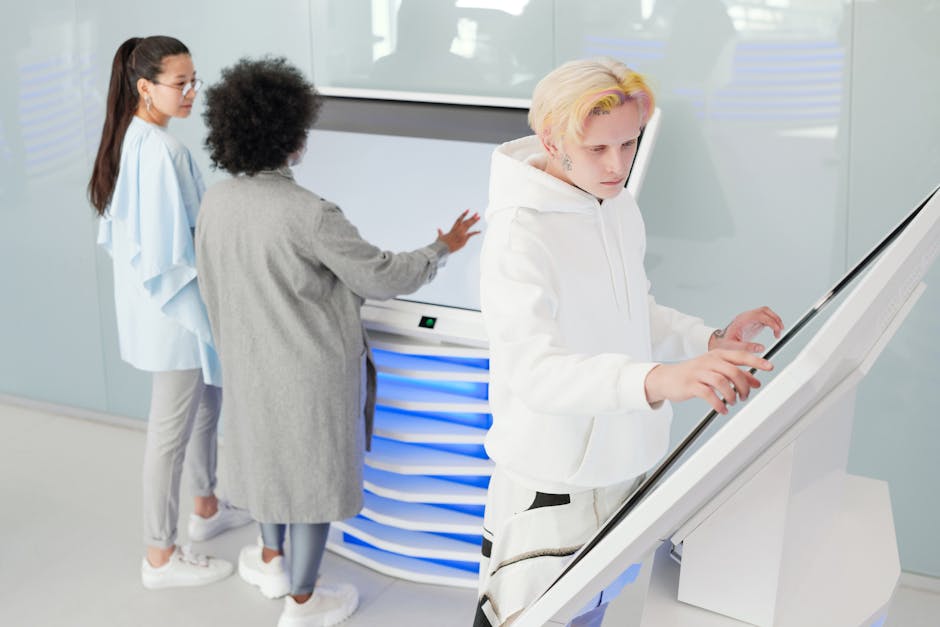
CAD software compatibility has reached maturity. Autodesk Fusion 360, SolidWorks, and Blender all offer native holographic display support, allowing engineers and designers to examine models with unprecedented detail. Rotating a complex mechanical assembly with your hands reveals stress points and clearance issues that flat screens simply cannot convey effectively.
Data visualization transforms when moved into three dimensions. Financial analysts now manipulate market data as floating charts and graphs, identifying patterns and correlations that remain hidden in traditional spreadsheet formats. Tableau and Power BI both support holographic output, with dedicated gesture libraries for common analytical tasks.
Large-Format Displays for Conference Rooms and Collaboration Spaces
Conference room installations center around the MegaHolo Conference System, a $15,000 solution that creates holographic displays up to 6 feet wide. Multiple presenters can interact with content simultaneously while maintaining eye contact with the audience—a crucial advantage over traditional projection systems that force presenters to turn away from viewers.
The system’s standout feature is seamless handoff capability. Start a presentation on your desktop holographic display, then transfer it instantly to the conference room system with identical positioning and scaling. Meeting participants see exactly what you’ve prepared, eliminating the usual technical difficulties of screen sharing and compatibility issues.
Spatial audio integration ensures that sound appears to originate from holographic objects themselves. When reviewing architectural plans, HVAC system sounds emerge from the appropriate building sections, creating immersive experiences that help stakeholders understand complex projects intuitively.
Training and Education Applications
Medical training has embraced holographic displays enthusiastically. The AnatomyHolo Pro ($8,900) allows medical students to examine detailed organ systems floating in space, dissecting virtual cadavers layer by layer without the ethical and practical constraints of traditional anatomy labs.
Corporate training scenarios benefit equally. New employees can practice equipment maintenance on holographic machinery before touching expensive real hardware. The procedural training reduces costs while improving safety outcomes across industries from manufacturing to aerospace.
Implementation Considerations and ROI Analysis
Space requirements vary significantly between devices. Desktop units need minimal modification to existing workstations, while large-format installations require dedicated rooms with controlled lighting and sufficient clearance around projection areas.
Power consumption runs higher than traditional monitors but remains reasonable for the capabilities provided. Most desktop units draw 80-120 watts, comparable to high-end gaming monitors. Large installations require dedicated 220V circuits, similar to high-end projection systems.
Cost Justification Strategies
Travel cost reduction provides immediate ROI for many organizations. Instead of flying team members to examine physical prototypes, holographic displays enable detailed remote collaboration on 3D models with the same level of interaction as in-person meetings.
Design iteration speed increases measurably when teams can manipulate 3D objects directly. Product development cycles that previously required weeks of back-and-forth communication now resolve in hours through real-time collaborative holographic sessions.
Training cost savings compound over time. Initial equipment investment pays for itself through reduced need for physical training materials, travel to training facilities, and instructor time per trainee.
Future-Proofing Your Holographic Display Investment
Software compatibility evolves rapidly in this space. Choose devices from manufacturers with strong developer ecosystems and regular firmware updates. Microsoft, Meta, and established display manufacturers offer the most reliable long-term support compared to startup companies with uncertain futures.
Connectivity standards matter for longevity. Devices supporting Thunderbolt 4, USB4, and Wi-Fi 6E will integrate better with future hardware generations. Avoid proprietary connection methods that could become obsolete.
The holographic display market is moving past the experimental phase into mainstream adoption. Early adopters are already seeing competitive advantages in collaboration efficiency, design quality, and training effectiveness. For organizations serious about staying ahead of workplace technology trends, the question isn’t whether to adopt holographic displays, but which devices best fit their specific needs and budget constraints. Start with a single desktop unit to evaluate workflow integration, then scale based on demonstrated value and user adoption rates.